



Bio, Demeter and EU Organic Baby Formula: What Each Label Means (2026)

A pack of European baby formula can carry the word bio, a green leaf logo, a code number and the name Demeter, all on the same label. They are not the same thing. EU Organic is a legal standard set by European regulation. Demeter is a separate, private biodynamic standard. This guide explains what each term means, what each mark on the pack tells you, and what none of them can tell you.
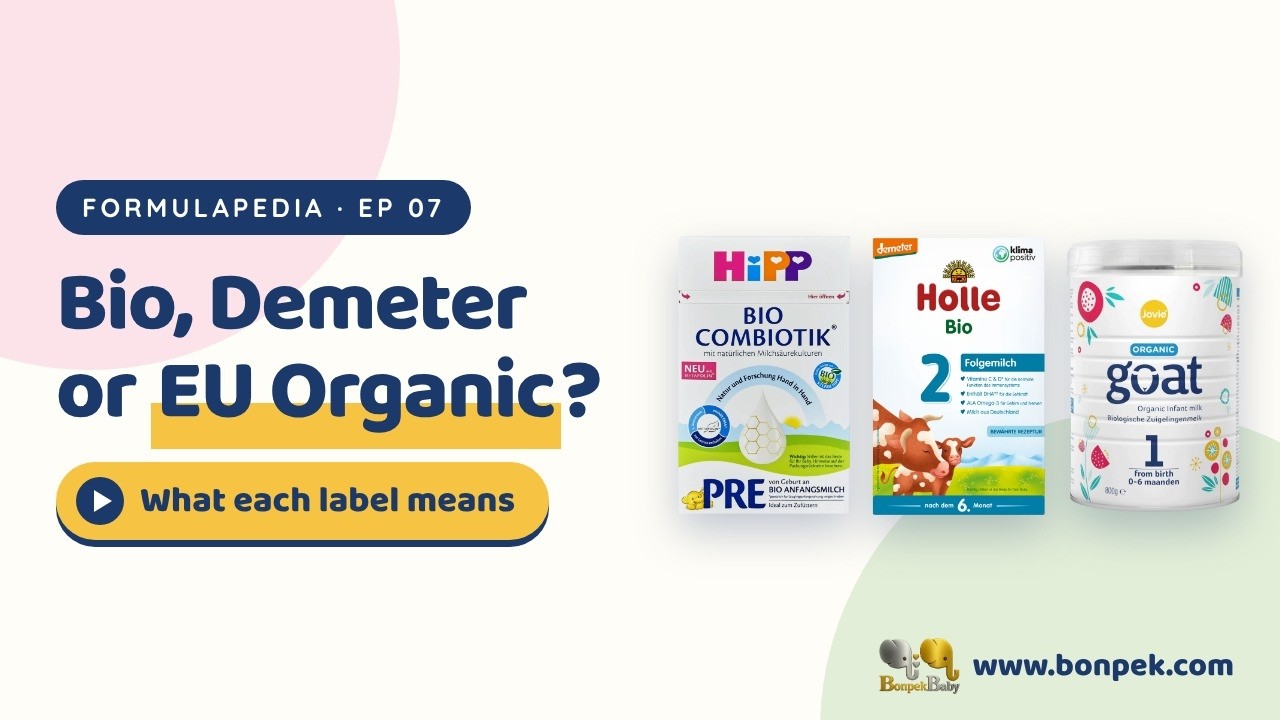
Watch the video version of this guide on YouTube. General information only, not medical advice. Always follow your pediatrician's guidance.
What You Will See on the Pack
| On the label | What it is |
|---|---|
| The word "bio", "eco" or "organic" | A protected term under EU organic law |
| The EU organic leaf logo | Mandatory on prepacked organic food sold in the EU |
| A code number | Identifies the certifier that inspects the producer |
| "EU Agriculture" or "non-EU Agriculture" | Where the farm ingredients were grown |
| The Demeter name or logo | A separate biodynamic standard from a private body |
What "Bio" and "Eco" Mean
In German and several other European languages, bio and eco mean the same as organic. They are not marketing words. Under Regulation (EU) 2018/848, these terms may be used only on products that comply with the EU organic rules, and terms or practices that could mislead the consumer are prohibited. So a HiPP German "Bio" pack is making a legal statement, and so is a Holle "Bio" pack.

A brand seal like this one is the manufacturer's own mark. It is not the EU organic logo. The legal marks are the leaf logo, the code number and the origin line, so look for those elsewhere on the pack.
The EU Organic Logo, Code Number and Origin Line
Regulation 2018/848 sets three label indications for organic food, and they work together:
- The code number of the control authority or control body that oversees the operator who carried out the last production or preparation step.
- The EU organic logo, the green leaf made of stars, which must appear on prepacked organic food.
- The place of farming, which must appear in the same field of vision as the logo whenever the logo is used. It reads EU Agriculture, non-EU Agriculture or EU/non-EU Agriculture, depending on where the farm ingredients were grown.

Find the code number and the origin line next time you pick up an organic formula. If one of them is missing from a prepacked organic product sold in the EU, ask the retailer or manufacturer.
The 95% Rule
For processed food, Regulation 2018/848 lets the organic terms appear in the sales description and the ingredient list only if the product meets the production rules and at least 95% of its agricultural ingredients by weight are organic. Below that level, the terms may appear only in the ingredient list. This is why the product name, not just the logo, is worth reading: it tells you which of the two situations you are in.
What Demeter Adds
Demeter is the certification mark of the international biodynamic community. According to Demeter International, the Demeter standard is based on the organic standard, and most certified products are certified to both. It adds requirements of its own, treats the farm as a single living system and does not allow partial conversion, since the whole farm must be certified. Inspection covers production, processing and distribution. The Demeter brand is held by the international biodynamic community, not by a company.

EU Organic is a legal standard set by European regulation. Demeter is a private standard that sits on top of organic farming. Neither one is a nutrition rating.
What the Labels Do Not Tell You
- Nutrition composition. The compositional rules for infant formula in Delegated Regulation (EU) 2016/127 apply to every infant formula sold in the EU. Organic status does not change that rulebook, and Demeter does not replace it.
- Pesticide limits. The same legal limit of 0.01 mg/kg per active substance applies to all infant formula under Regulation 2016/127, organic or not. Organic rules work upstream, on how the farm ingredients are grown.
- The whole range. Certification belongs to a specific product, not to a brand. A brand can sell organic and non-organic lines side by side, so check each pack.
- Ingredients you may care about. Organic status does not decide which fats, carbohydrates or probiotics a formula uses. Read the ingredient list. Our guide to reading a European formula label shows how.
Examples From Bonpek Brands
| Line | Certification (from our ingredients guide) |
|---|---|
| HiPP German Bio Combiotik infant range | EU Organic across the line |
| HiPP toddler milks (Kindermilch and Junior) | Not Bio and not EU Organic certified |
| Holle PRE, Stage 1, 2 and 3 (cow and goat) | EU Organic plus Demeter biodynamic |
| Holle Stage 4 (cow and goat) | EU Organic only, without Demeter |
| Jovie goat range | EU Organic |
| Kendamil Goat | Not EU Organic certified |
| NannyCare | Not organic-certified |
The pack in your hands is the final word, because lines and certifications can change. Look for the logo, the code number and the origin line. Browse HiPP formulas or browse Holle formulas. For how organic formulas handle fats, see our guide to organic formula and palm oil; for a wider comparison with US formula, see European vs. American baby formula.
 Holle PRE
 Holle Goat Stage 1
 HiPP Pre
Frequently Asked Questions
Does bio mean organic?
Yes. Under Regulation (EU) 2018/848, bio and eco are protected terms equivalent to organic, and they may be used only on products that comply with the EU organic rules.
What is the green leaf logo on European formula?
It is the EU organic logo. For prepacked organic food it appears with the control body's code number and an origin line such as EU Agriculture.
Is HiPP's round Bio seal the same as the EU organic logo?
No. The round seal on the front of a HiPP box is HiPP's own brand mark. The EU organic logo is the green leaf, and it comes with a code number and an origin line.
What does EU Agriculture mean?
It states that the agricultural raw materials were farmed in the EU. The alternatives are non-EU Agriculture and EU/non-EU Agriculture, depending on where the ingredients were grown.
Is Demeter the same as organic?
No. Demeter is a separate biodynamic standard. According to Demeter International it is based on the organic standard, and most Demeter products are certified to both.
Is organic formula safer or more nutritious than non-organic formula?
The labels do not say so. All infant formula sold in the EU must meet the same composition rules, and the same pesticide residue limit applies to all of it. Organic and Demeter describe how ingredients are farmed and processed.
Which Bonpek formulas carry Demeter?
Holle PRE, Stage 1, Stage 2 and Stage 3, in both cow and goat milk. Holle Stage 4 is organic but does not carry Demeter. Always check the pack and the product page for the stage you are buying.
Dejar un comentario