






Palm Oil in Baby Formula: Which European Formulas Avoid It

Many parents search for palm oil free baby formula and wonder whether palm oil in infant formula is a problem. Here is the short version. Palm oil is permitted in European baby formula, it is used to shape the fat blend, and a major pediatric nutrition committee found insufficient evidence that it should be avoided. Some parents still prefer a formula without it, and that is a reasonable preference. This guide explains the rules, the research, how to read a label, and which of the lines we carry list palm oil and which do not.
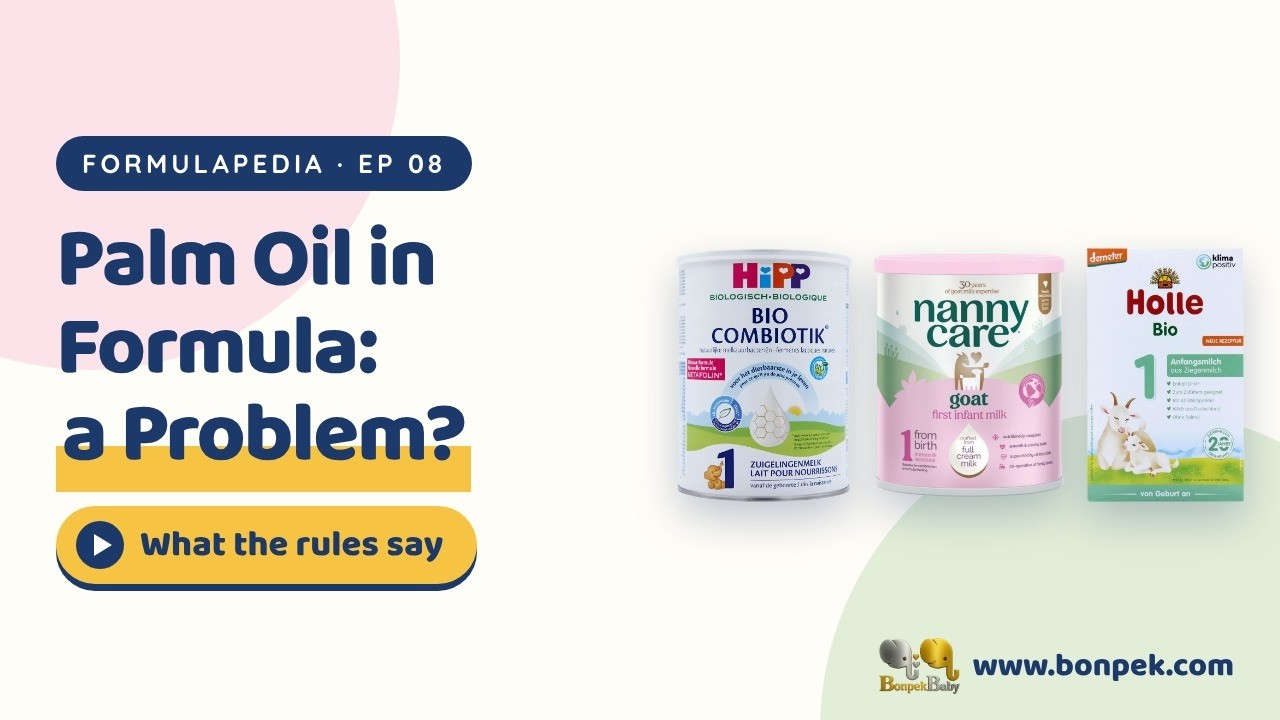
Watch the video version of this guide on YouTube. General information only, not medical advice. Always follow your pediatrician's guidance.
What the EU Rules Say About Palm Oil
Under Commission Delegated Regulation (EU) 2016/127, infant formula must contain 4.4 to 6.0 g of fat per 100 kcal and meet limits for individual fatty acids. The rules prohibit sesame seed oil and cotton seed oil. They do not prohibit palm oil, and they do not require it. Which oils go into the blend is the manufacturer's recipe choice, and the same fat rules apply whether a formula uses palm oil or not.
Why Formula Uses Palm Oil
Human milk fat contains a lot of palmitic acid. Manufacturers add palm oil to bring the palmitic acid level of a vegetable oil blend closer to that of human milk. Most formula fat blends combine several oils, for example rapeseed, sunflower and sometimes palm or coconut oil. Some formulas build more of the fat profile around milk fat instead. Kendamil's cow's milk range, for example, is built on whole milk. Our whole milk and skimmed milk guide covers how the milk base affects the fat blend.
What the Research Says
The ESPGHAN Committee on Nutrition published a position paper in 2019 on palm oil and beta-palmitate in infant formula, in the Journal of Pediatric Gastroenterology and Nutrition. Its main points were:
- Stools: palm oil in formula is associated with harder stools, while formulas with more palmitic acid in the sn-2 position, known as beta-palmitate, may give softer stools. The authors describe this as a short-term effect and say a high sn-2 palmitate blend cannot be considered essential.
- Bone: the effects on bone appear to be short-lasting.
- Growth: infant growth is not influenced.
- Overall: the committee found "insufficient evidence to suggest that" palm oil should be avoided in infant formula, and described the evidence on colic, gut bacteria and later health as limited or inconclusive.
Palm oil is a permitted, widely used fat source. Parents who prefer a formula without it have several choices in the European ranges. Parents whose baby is comfortable on a formula that contains palm oil have no research-based reason to switch on that basis alone.
Which Lines List Palm Oil, and Which Do Not
This is where most guides oversimplify, because the answer is set by the individual recipe rather than by the brand name. The clearest example is Holle: the cow's milk formulas and the goat milk formulas give different answers.
| Line | Palm oil in the ingredient list |
|---|---|
| Holle cow's milk formulas (PRE through Stage 4, German and Dutch) | Yes. Palm oil appears in the vegetable oil blend, footnoted by Holle as from sustainable cultivation |
| Holle goat milk formulas (PRE through Stage 4, German and Dutch) | No. Sunflower and rapeseed oil instead |
| HiPP Bio Combiotik powders, German and Dutch, and HiPP goat | Yes. Organic palm oil in the vegetable oil blend |
| HiPP ready-to-feed liquid milks | No. The liquid recipe differs from the powder |
| Kendamil Organic, Bio Nature and Kendamil Goat | No |
| Jovie goat milk | No |
| NannyCare goat milk | No |
Recipes are revised from time to time and differ between markets, so the ingredient list on the pack in your hand is the final word. Our European formula ingredients guide goes through the rest of the ingredient list in the same way.

Kendamil builds its fat profile around whole organic cow's milk fat rather than a vegetable oil blend, and uses algae-derived DHA rather than fish oil. Browse Kendamil formulas.

The Holle goat milk range uses sunflower and rapeseed oil in place of palm oil, and Holle prints that on the pack. See the goat milk options.

The Holle cow's milk formulas from PRE to Stage 3 are Demeter certified, which is the strictest of the organic farming standards behind the European brands, and the vegetable oil blend in the Holle cow's milk formulas does include palm oil. Both things are true at once, which is why the farming standard and the fat blend are worth reading as two separate questions. Browse Holle formulas or browse HiPP formulas.
Processing Contaminants in Refined Oils
EU regulation also sets maximum levels for 3-MCPD and glycidyl fatty acid esters in infant formula. These are processing contaminants that can form when vegetable oils are refined, and the limits for foods made for infants are stricter than for most other foods. They have been tightened over time, for example by Regulation (EU) 2020/1322 and Regulation (EU) 2024/1003. The limits apply to the finished formula whatever oils it contains, so they are not a feature of any one brand.
How to Spot Palm Oil on a Label
Read the ingredient list on the pack, where ingredients appear from the largest amount to the smallest. Look for:
- Palm oil, palm fat or palm olein, in German Palmöl or Palmfett, often shown inside a bracket after "vegetable oils".
- Vegetable oils followed by the names of the oils, which is what tells you the blend.
- Beta-palmitate, OPO or sn-2 palmitate, a structured fat. It is not the same as palm oil free, and where palm oil is its source, palm oil still appears in the list.
- A footnote marker next to an oil. Holle, for example, footnotes its palm oil as from sustainable cultivation, so the footnotes are worth reading as well as the list.
Choosing
If you would prefer a formula without palm oil, check the ingredient list for each stage you plan to buy, because a brand can answer differently at different stages and in different markets. If your baby is comfortable on their current formula, that is not on its own a reason to change. If you do decide to change, follow your pediatrician's advice and our guide to switching baby formula safely. For hard stools, constipation or ongoing fussiness, speak to your pediatrician before changing anything.
For a wider comparison of the brands and the organic certifications behind them, see our European baby formula comparison guide.

Frequently Asked Questions
Is palm oil allowed in European baby formula?
Yes. Regulation (EU) 2016/127 prohibits sesame seed oil and cotton seed oil but not palm oil, and it sets the same fat rules for every infant formula.
Is palm oil bad for babies?
The ESPGHAN Committee on Nutrition found insufficient evidence to suggest that palm oil should be avoided in infant formula. Some studies associate it with harder stools, and the authors describe such effects as short-term.
Does Holle formula contain palm oil?
It depends on the milk. Holle's cow's milk formulas list palm oil in the vegetable oil blend, footnoted as from sustainable cultivation. Holle's goat milk formulas list no palm oil and use sunflower and rapeseed oil instead.
Does HiPP formula contain palm oil?
The HiPP Bio Combiotik powders and HiPP goat list organic palm oil. The HiPP ready-to-feed liquid milks do not, because the liquid recipe differs from the powder.
What is beta-palmitate, and is it the same as no palm oil?
Beta-palmitate, also called OPO or sn-2 palmitate, is a fat structure in which more palmitic acid sits in the middle, sn-2, position, as in human milk. It can be made from palm oil, so it is not the same as palm oil free.
How do I know if a formula contains palm oil?
Read the ingredient list on the pack for palm oil, palm fat or palm olein, often inside a bracket after vegetable oils, or Palmöl on German packs, and read the footnotes under the list.
Which formulas at Bonpek Baby list no palm oil?
Kendamil Organic, Bio Nature and Kendamil Goat; the Holle goat milk range; Jovie goat milk; NannyCare goat milk; and the HiPP ready-to-feed liquid milks. Always confirm on the ingredient list for the stage you are buying.
Dejar un comentario