







European Formula Ingredients: A Parent's Guide
Last Updated: November 18, 2026
Quick Summary
European formula ingredients for infant nutrition start with a short list: lactose as the main carbohydrate, cow's milk proteins, and a blend of plant and algal oils for fat. Functional extras like probiotics, prebiotics, and human milk oligosaccharides are layered on top. European labels express nutrients per 100 ml or per 100 kcal, so convert units before comparing.
- Lactose is the carbohydrate most European first infant formulas use as their only carbohydrate source.
- First infant formula is whey-dominant, while follow-on formula shifts toward casein.
- DHA is required in European infant formula above a set threshold, with a maximum.
- Convert 100 ml to fluid ounces by dividing by 29.57 before comparing labels.
- HiPP PRE pairs GOS prebiotic fiber with Lactobacillus fermentum hereditum, a live culture.
Table of Contents
- What European Formula Ingredients Actually Contain
- European vs. American Baby Formula Standards Compared
- How to Read a European Formula Label and Convert Units
- European Baby Formula Without Seed Oils and Palm Oil
- The Best European Baby Formula Brands for Infant Nutrition
- Where to Buy European Baby Formula Without Customs Delays
- Choosing Your Baby's European Formula at Bonpek Baby
- Frequently Asked Questions
What European Formula Ingredients Actually Contain
European formula ingredients for infant nutrition start with a short list: lactose as the main carbohydrate, cow's milk proteins, and a blend of plant and algal oils for fat. A 2023 review in PubMed Central's infant formula ingredient review describes infant formula as typically built from carbohydrates, fats, proteins, vitamins, and minerals, with functional extras like probiotics, prebiotics, and human milk oligosaccharides layered on top.
Lactose, Milk Proteins, and Fatty Acids in the Ingredient List
Lactose is the sugar naturally found in milk and the carbohydrate most European first infant formulas use as their only carbohydrate source. Milk proteins come in two types, whey and casein, and their ratio changes by stage: first infant formula is whey-dominant, follow-on formula shifts toward casein. Fatty acids include DHA and ARA, the long-chain fats added for brain and eye development.
Children's Hospital Colorado's guide to European infant formulas notes that European formulas commonly use lactose as the primary carbohydrate and include DHA. A 2023 international survey in BMJ's infant formula claims study found long-chain polyunsaturated fatty acids were the most cited ingredient group in health claims, appearing on 278 products, or 46% of the sample.
For a deeper ingredient-by-ingredient breakdown, see our guide to European formula ingredients explained.
European vs. American Baby Formula Standards Compared
The core difference is regulatory, not nutritional. European formulas are made under EU regulations, while formulas sold in the United States must meet FDA requirements. Neither system is automatically "cleaner"; they set nutrient ranges and labeling rules differently. The useful comparison is ingredient by ingredient, with the current rule cited for each side, because the rules on both sides are moving.
Nutrient Ranges, Labeling, and Required Nutrients
European labels express nutrients per 100 kcal or per 100 ml, while US labels use per 100 kcal with a different reference base. A 2019 study in PubMed's comparison of imported European and US infant formulas compared internet-purchased European formulas against FDA labeling and nutrient requirements, and found meaningful gaps between what the labels claimed and what US rules require. A separate 2023 study in PubMed Central's iron and DHA analysis reported that iron and DHA levels in some US-purchased formulas did not meet the study's referenced European requirements.
Here is the ingredient-by-ingredient comparison that most explainers skip. Each row names the nutrient, the European rule, the US rule, and the practical difference a caregiver would notice on a label.
| Nutrient | European rule | US rule | Practical difference |
|---|---|---|---|
| Protein | Minimum and maximum set per 100 kcal; whey-dominant first formulas common | Minimum set per 100 kcal; no whey-to-casein ratio required | European first formulas tend to be whey-dominant; US formulas vary by brand |
| Carbohydrate | Lactose required as the main carbohydrate in standard infant formula; other sugars restricted | No single carbohydrate required; corn syrup solids and maltodextrin common | A European label often lists lactose alone; a US label often lists lactose plus a second carbohydrate |
| DHA | Required in infant formula above a set threshold, with a maximum | Permitted, not required; amount varies by brand | DHA appears on most European first-formula labels; on US labels it is brand-dependent |
| Iron | Range set per 100 kcal | Minimum set per 100 kcal; most US formulas are fortified well above the minimum | US formulas are often higher-iron; European formulas sit inside a narrower range |
| Palm oil | Permitted; frequently omitted in organic lines | Permitted; commonly used | Palm-oil-free is a label claim in Europe, not a regulatory category |
| Label units | Per 100 ml prepared and per 100 kcal | Per 100 kcal, with prepared-volume figures on the label | Direct comparison requires converting to the same denominator |
| Feature | European Formula | US Formula |
|---|---|---|
| Regulator | EU regulations | FDA requirements |
| Carbohydrate base | Usually lactose only | Often lactose plus corn syrup solids |
| Label units | Per 100 ml / 100 kcal | Per 100 kcal |
| Palm oil | Frequently omitted | Commonly used |
| Protein base | Whey-dominant at stage 1 | Varies by brand |
The FDA issued the first of three planned proposed rules on October 29, 2026, to update infant-formula nutrient requirements and labeling, according to the FDA infant formula homepage. That means US standards are actively moving, which is worth knowing before you assume one system is frozen in place. The European side is not static either: EU rules on infant formula composition have been revised in recent years, and the permitted ranges on a label reflect the rule in force when that batch was produced, not the rule today.
Watch out: a label comparison is only valid if both products are compared on the same denominator. A per-100 ml European figure and a per-100 kcal US figure are not the same measurement, and comparing them directly will misstate the difference every time.
For the full side-by-side, read our European vs American baby formula comparison.
How to Read a European Formula Label and Convert Units
Reading a European label comes down to three moves: find the stage, find the preparation table, and convert the units. European boxes print nutrition per 100 ml of prepared formula, not per scoop, so you need the mixing ratio before any number means anything.
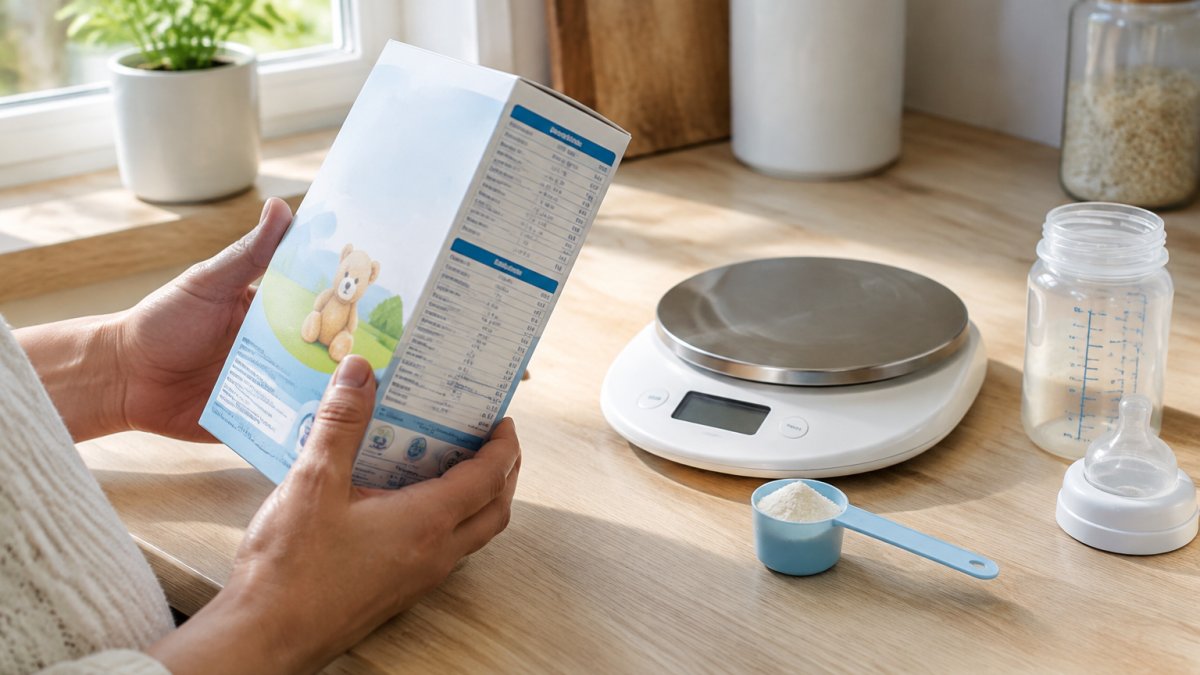
Here is the conversion checklist we walk parents through:
- Confirm the stage: PRE and Stage 1 cover birth to 6 months, Stage 2 is follow-on from 6 months
- Note the scoop size in grams and the water volume in milliliters
- Convert 100 ml to fluid ounces by dividing by 29.57
- Multiply per-100 ml values by your actual bottle volume
- Check the age range printed on the box, not the number on the front
One common mistake is comparing a per-100 ml European figure directly against a per-100 kcal US figure. They are not the same denominator, and the comparison will mislead you every time.
Our step-by-step walkthrough on how to read a European baby formula label covers each line on the box.
European Baby Formula Without Seed Oils and Palm Oil
Palm oil is a common question for parents, and many European organic formulas leave it out, while some replace it with sunflower or rapeseed oil. Seed oils are not banned in European formulas; they are simply one fat source among several.
Kendamil Bio Nature Stage 1 is built on organic whole milk and organic cream with no palm oil, no fish oil, and no maltodextrin, and it keeps the milk fat globule membrane intact rather than rebuilding fat from vegetable oils. That whole-milk base is unusual.
The trade-off is real: whole-milk formulas are richer and some babies digest them differently than skimmed-milk recipes. If your baby has tolerated a leaner formula, switching to a cream-based one is a change worth making one bottle at a time.
For palm-oil-free options across the range, browse our guide to organic baby formula without palm oil.
The Best European Baby Formula Brands for Infant Nutrition
Several brands are prominent on the European organic shelf, and each has a distinct ingredient approach. HiPP pairs prebiotics with a live probiotic culture. Holle leans on Demeter biodynamic milk and the shortest recipe of the three. Kendamil builds on whole milk and cream. The differences that matter most are not on the front of the box, they are in the carbohydrate source, the protein ratio, the fat base, and the certification behind the milk.
HiPP, Holle, and Kendamil Ingredient Profiles
HiPP Stage PRE Bio Combiotik uses lactose as its only carbohydrate with no starch, and pairs GOS prebiotic fiber with Lactobacillus fermentum hereditum, a live culture.
Holle PRE is the only formula in our range carrying Demeter biodynamic certification on top of EU Organic. Its carbohydrate is organic lactose alone, with DHA from algae oil and no starch or maltodextrin.
Kendamil Bio Nature Stage 1 runs a 60:40 whey-to-casein ratio on organic whole milk and cream, with algae DHA and no palm oil. An 800 g can makes roughly 210 fl oz and costs $53.99.
| Brand | Carbohydrate | Certification | Protein Base | Price |
|---|---|---|---|---|
| HiPP PRE | Lactose only | EU Organic | Skimmed milk + whey | $36.99 / 600 g |
| Holle PRE | Lactose only | EU Organic + Demeter | Demeter skimmed milk | $25.99 / 400 g |
| Kendamil Bio Nature 1 | Lactose | EU Organic | Whole milk + cream | $53.99 / 800 g |
Watch out: certification logos are easy to misread. EU Organic and Demeter are separate marks with separate rules, and a box that carries one does not automatically carry the other. Check the seal on the specific product you are buying, not the brand's homepage.
You can view and buy the HiPP Stage 1 organic combiotic first infant milk directly.
Prices of European baby formula brands
Where to Buy European Baby Formula Without Customs Delays
Importing formula yourself means customs holds, import fees, and no control over how long a box sat in transit. Buying from US stock removes all three problems at once.
Bonpek Baby ships European formula from US stock, so your order ships domestically with no customs holds and no import costs. Our catalog covers HiPP, Holle, Kendamil, and Jovie, produced under EU standards, with EU Organic and Demeter biodynamic certification on the lines that carry it. We offer price matching and same-day local pickup and delivery in Los Angeles.
Watch out: third-party resellers sometimes repackage boxes, and a resealed European carton is not the same product. Buy from a source that ships the original sealed box.
Choosing Your Baby's European Formula at Bonpek Baby
The ingredient list on a European formula is short and readable, but the choice still comes down to your baby. A whey-dominant first formula suits a newborn; a cream-based recipe suits a baby who has done well on richer milk; a Demeter-certified option suits a family that wants the strictest farming standard on the shelf.
We stock all three profiles from US warehouses, so you are not gambling on a customs timeline. Every order ships from domestic stock, and over 1,361 verified customer feedbacks back the service.
Choosing a first formula is a decision most parents make once and second-guess for months. Bonpek Baby removes the logistics from that decision: domestic shipping with no customs holds, price matching against other US sources, and same-day pickup or delivery in Los Angeles. Browse the range, compare the labels, and order with confidence.
Frequently Asked Questions
Are European baby formulas better than US formulas?
Not automatically. European formula follows EU regulations, while US formula follows FDA requirements, and both set nutrient ranges designed to support infant nutrition. The practical difference often comes down to ingredient choices like lactose as the primary carbohydrate or palm oil avoidance, not overall superiority. Talk to your pediatrician before switching.
Do European baby formulas contain seed oils?
Some do and some do not. Many European formulas use sunflower, rapeseed, or palm oil in the fat blend, while others build on whole milk and cream instead. Kendamil Bio Nature, for example, uses organic whole milk plus organic cream with no palm oil, no fish oil, and no maltodextrin. Read the ingredient list rather than assuming a European origin means seed-oil-free, and check the fat sources line by line before you buy.
How do European and US infant formula ingredients differ?
European formula commonly highlights lactose as the primary carbohydrate and includes DHA, according to Children's Hospital Colorado. US formulas may use different carbohydrate sources and iron levels. Compare the nutrient composition per 100 kcal on both labels.
Where can I buy authentic European baby formula in the US?
Buy from a US-based supplier that ships from domestic stock so you avoid customs holds and import fees. Bonpek Baby stocks HiPP, Holle, Kendamil, and Jovie with same-day local pickup and delivery in Los Angeles and fast shipping. Prices start at $25.99 for Holle PRE 400 g and $36.99 for HiPP PRE Bio Combiotik 600 g.

Leave a comment