







How Long Does Liquid Baby Formula Last: Storage Timelines
Last Updated: November 8, 2026
Quick Summary
Liquid baby formula lasts up to two hours at room temperature once prepared, 24 hours in the refrigerator once prepared, and up to 48 hours in the refrigerator for an opened ready-to-feed container that has never been fed from. Always follow the shorter of the label limit and these general timelines.
- An unopened container has no running clock; use it by the date printed on the pack.
- A bottle your baby has fed from must be discarded after one hour from the start of the feed.
- Keep the fridge at 40°F or below and store bottles toward the back, not in the door.
- Never freeze liquid formula, and do not return a bottle to the fridge after your baby has fed from it.
- Warm bottles under running warm water or in a bowl of warm water, never in a microwave.
Table of Contents
- Liquid Baby Formula Storage: The Timelines That Actually Matter
- Ready to Feed Formula Storage After Opening: Unopened vs Opened Containers
- How Long Does Liquid Baby Formula Last at Room Temperature?
- How Long Does Liquid Baby Formula Last in the Refrigerator?
- What Happens If Baby Drinks Formula After 2 Hours?
- A Decision Tree for Poured, Refrigerated, Warmed, or Offered Formula
- Travel, Transport, and the Practical Temperature Rules
- Stocking Your Shelf With Ready-to-Feed Formula
- Frequently Asked Questions
Liquid Baby Formula Storage Time Limits by Container State
Liquid Baby Formula Storage: The Timelines That Actually Matter
How long does liquid baby formula last?
Liquid formula is different from powder. It has no scooping step and no mixing errors, but it spoils on a tighter clock once air touches it.
Below, we break down each timeline by formula type and container state.
Most feeding guides treat all formula the same. It is not. Ready-to-feed and liquid concentrate behave differently once opened, and a bottle your baby has already touched follows its own rule.
Ready to Feed Formula Storage After Opening: Unopened vs Opened Containers
Ready-to-feed formula storage after opening follows one rule set, and unopened containers follow another. The container state decides which clock starts, and for opened containers the product label is the final authority.
Unopened Containers: Check the Date, Not the Clock
An unopened container has no running clock. Store it at room temperature, away from direct heat and sunlight, and use it by the date printed on the pack.
- Keep the container dry and out of the car trunk
- Do not freeze liquid formula
- Check the date before each feed, not after
Once the seal breaks, the rules change completely.
Opened Containers: The Label Sets the Limit
This is where most guidance gets muddy. The CDC's infant formula preparation and storage guidance describes a general limit of 48 hours in the refrigerator for opened ready-to-feed containers, but the manufacturer's label on your specific pack may state a shorter window.
A practical way to read the label:
- "Use within 48 hours of opening", the container keeps up to 48 hours refrigerated, covered, and never fed from directly.
- "Use within 24 hours of opening", the container keeps up to 24 hours refrigerated under the same conditions.
- "Do not refrigerate after opening", rare for ready-to-feed, but if stated, follow it and discard what is not used in the feeding.
Watch out: an opened container that has been held to a baby's mouth is no longer an opened container in the storage sense. It is a fed-from bottle, and the one-hour feeding rule applies instead of the 48-hour container rule.
Opened Container vs. Prepared Bottle: Two Different Clocks
The distinction that resolves most confusion:
| State | What it is | Time limit |
|---|---|---|
| Unopened ready-to-feed | Sealed container | Use by printed date |
| Opened ready-to-feed, never fed from | Container in fridge, covered | Up to 48 hours, or the label limit if shorter |
| Ready-to-feed poured into a bottle, never fed from | Prepared bottle | 2 hours at room temperature, 24 hours refrigerated |
| Bottle a baby has fed from | Fed-from bottle | 1 hour, then discard |
Pour what you need into a bottle and put the container back in the fridge right away. Do not leave it on the counter between feeds, and do not pour unused formula from a bottle back into the container. If you want a dedicated place to keep an opened pack sealed between feeds, our HiPP formula storage airtight container does that job.

Liquid Concentrate After Opening
Liquid concentrate follows a different opened-container rule than ready-to-feed. An opened can of concentrate that has been mixed with water is prepared formula, so the 24-hour refrigeration clock starts at mixing. An opened can that has not yet been mixed should be covered and refrigerated, and any concentrate left in the can should be discarded after 48 hours per the label.
How Long Does Liquid Baby Formula Last at Room Temperature?
Liquid baby formula lasts up to two hours at room temperature once prepared. After that, bacteria can multiply to levels that are unsafe for an infant, so the formula should be thrown out.
This is the limit most parents get wrong. The clock starts when you mix or pour the formula, not when you start feeding. A bottle sitting on the counter while you change a diaper is already counting down.
The Two-Hour Rule and the One-Hour Feeding Rule
Two different clocks apply, and they are easy to confuse:
- Two hours: prepared formula left untouched at room temperature
- One hour: formula in a bottle your baby has started drinking from
- Discard either one when its clock runs out
The reason for the shorter feeding limit is simple. Saliva from your baby's mouth enters the bottle during feeding, and that introduces bacteria (the CDC). Formula that was safe at minute five is not automatically safe at minute sixty-five.
How Long Does Liquid Baby Formula Last in the Refrigerator?
Prepared liquid formula is generally kept in the refrigerator for up to 24 hours, and an opened ready-to-feed container that has not been fed from follows the label's refrigerated window.
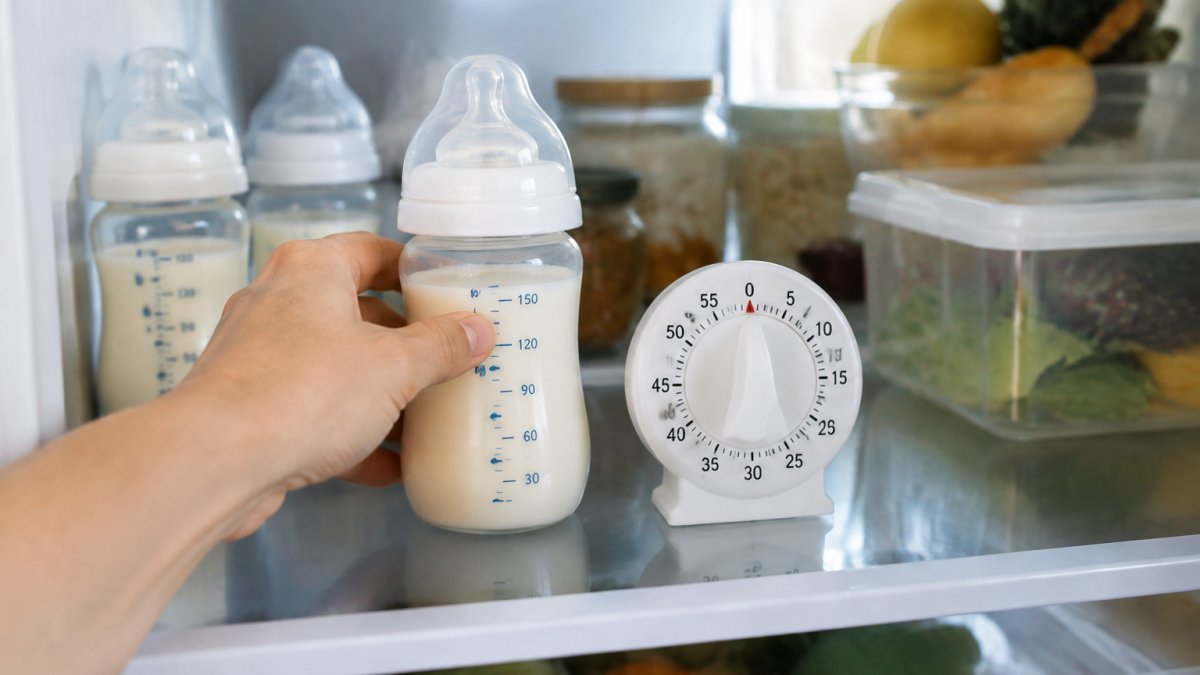
Label each bottle with the time you prepared it. A strip of masking tape and a marker solves the "was this from this morning or last night" problem in seconds.
Watch out: do not refreeze formula, and do not return a bottle to the fridge after your baby has fed from it. The one-hour feeding rule overrides refrigeration.
Liquid Concentrate: Mix First, Then Refrigerate
Liquid concentrate has to be mixed with water before it counts as prepared formula. Mix it exactly as the label directs, then start the 24-hour refrigeration clock.
- Mix with the full amount of water the label states
- Stir, do not shake, to limit foam
- Refrigerate immediately after mixing
Concentrate that has been mixed and never fed from keeps 24 hours. Once it goes into a bottle and your baby drinks, the one-hour rule takes over.
What Happens If Baby Drinks Formula After 2 Hours?
Nothing may happen, and that is the trap. Formula left out for more than two hours can carry bacteria that cause vomiting, diarrhea, or worse in an infant.
If your baby did drink formula that sat out too long, watch for these signs over the next 24 hours:
- Repeated vomiting
- Diarrhea
- Refusing feeds
Call your pediatrician if any of these appear. Do not wait to see whether it passes.
If you are worried about how much your baby takes in at each feed, our feeding chart by age covers typical amounts and hunger cues.
A Decision Tree for Poured, Refrigerated, Warmed, or Offered Formula
Use this sequence when you are standing in the kitchen holding a bottle and unsure what to do. It is written for liquid formula specifically, because ready-to-feed and concentrate branch differently once opened.
Step 1: Has a baby fed from this bottle?
- Yes, discard after one hour from the start of the feed, no exceptions. Saliva introduces bacteria, and refrigeration does not undo that.
- No, go to Step 2.
Step 2: Is this an opened container or a prepared bottle?
- Opened ready-to-feed container, never fed from, refrigerate covered and use within 48 hours, or the label limit if shorter. Go to Step 4 to confirm temperature handling.
- Opened liquid concentrate can, not yet mixed, cover, refrigerate, and discard any remaining concentrate after 48 hours per the label.
- Prepared bottle (ready-to-feed poured, or concentrate mixed with water), go to Step 3.
Step 3: Where has the prepared bottle been?
- On the counter under two hours, refrigerate now and use within 24 hours of preparation.
- On the counter over two hours, discard.
- In the fridge under 24 hours, safe to use; warm only the amount you will feed.
Step 4: Was it warmed?
- Warmed but never fed from, use within two hours and do not put it back in the fridge. Rewarming a bottle that has already been warmed increases the time it spends in the temperature range where bacteria grow.
- Warmed and fed from, discard after one hour from the start of the feed.
- Warmed in a microwave, do not. Microwaves heat unevenly and can create hot spots that burn a baby's mouth. Warm under running warm water or in a bowl of warm water instead.
Step 5: Has a storage limit already been exceeded?
Discard it. Do not taste it, do not smell it, and do not judge by appearance. The bacteria that cause infant illness in formula are not detectable by senses, and a formula that looks and smells normal can still be unsafe.
| Situation | Time Limit | Action |
|---|---|---|
| Prepared, at room temp, untouched | 2 hours | Refrigerate or discard |
| Prepared, refrigerated | 24 hours | Use or discard |
| Opened ready-to-feed, refrigerated, never fed from | 48 hours or label limit | Use or discard |
| Opened concentrate, unmixed, refrigerated | 48 hours or label limit | Discard remainder |
| Bottle baby has fed from | 1 hour | Discard |
| Warmed, never fed from | 2 hours | Do not re-chill |
| Frozen liquid formula | Never | Do not freeze |
A common mistake is tasting the formula to check it. Your palate cannot detect the bacteria that matter here. Trust the clock instead.
When to Ask a Clinician Instead
For premature infants, babies with weakened immune systems, or babies with a feeding tube or other medical device, general handling timelines may not be sufficient. Ask your pediatrician or the feeding team for individualized storage guidance, and follow their instructions over the general rules above.
Travel, Transport, and the Practical Temperature Rules
Travel is where storage rules break down, because most diaper bags are warm and none of them have a thermometer. Pack formula the way you would pack food for yourself.
- Carry powder or unopened ready-to-feed, not pre-mixed bottles
- Use an insulated cooler with an ice pack for any prepared bottle
- Keep the cooler out of direct sun and off the car floor
For powder feeds on the go, our HiPP portable formula portion dispenser storage carries three pre-measured portions in one screw-together stack, so you are not counting scoops at a restaurant table.

If you are traveling with ready-to-feed, keep the container sealed until you are ready to pour. An unopened container needs no cooler at all.
Stocking Your Shelf With Ready-to-Feed Formula
Ready-to-feed is the simplest option for parents who want fewer steps and less room for error. There is no mixing, no water quality question, and no scoop to level.
For stocking up, our HiPP 1 Bio Combiotik organic starter milk ready-to-feed is a ready-to-feed option from the HiPP line.

A few habits keep your shelf in good shape:
- Rotate older containers to the front
- Store away from the stove and any heat source
- Keep the outer packaging until the date is checked
The timelines are simple once you know which clock applies: two hours out, 24 hours prepared in the fridge, 48 hours for an opened ready-to-feed container, and one hour once your baby has fed. The hard part is staying consistent on tired nights.
Bonpek Baby offers European baby formulas shipped from US stock, with same-day local pickup and delivery in Los Angeles and responsive customer support.
Frequently Asked Questions
How long can liquid formula last once opened?
It depends on the type. An opened container of ready-to-feed liquid formula keeps up to 48 hours in the refrigerator, according to the manufacturer's label, and must be discarded after that window even if it looks and smells fine. Liquid concentrate that has been mixed with water follows the prepared-formula rule: use within 2 hours at room temperature or within 24 hours refrigerated. Always check the specific product label, since brands can set shorter limits than the general guidance.
Can I save a half-drank bottle of formula?
No. Once your baby's mouth has touched the bottle, saliva introduces bacteria that multiply quickly in liquid baby formula, and the one-hour clock starts from the beginning of that feeding. Discard whatever is left after one hour. If you expect your baby to take only part of a feed, pour the amount you think they will drink into a separate feeding bottle and keep the rest in the original container in the refrigerator, so the untouched portion is not wasted.
What happens if I feed my baby 3-hour-old formula?
Formula that sat at room temperature for three hours has been outside the two-hour safety limit, and bacteria may have multiplied to levels that can cause stomach upset or more serious illness in an infant. Do not feed it. Throw it out and prepare a fresh bottle. If your baby already drank the older formula, watch for vomiting, diarrhea, or unusual fussiness and call your pediatrician if symptoms appear. When in doubt, discard: the cost of one bottle is far less than the risk.
How long does unopened liquid baby formula last?
Unopened ready-to-feed and liquid concentrate containers keep until the use-by date printed on the package, as long as they are stored at room temperature and not exposed to extreme heat or freezing. That date assumes the seal is intact, so never buy or use a container with a bulging lid, dented rim, or damaged seal. Once you open it, the clock resets to the shorter refrigerated window on the label.

Leave a comment