







Lactose, Glucose Syrup and Maltodextrin in Baby Formula: What the Label Means (2026)

Flip a European baby formula pack over and the carbohydrate line can read lactose, maltodextrin, glucose syrup or starch. Parents often ask which of these belong in an infant formula and which are a warning sign. The rulebook is clearer than the internet. Delegated Regulation (EU) 2016/127 lists exactly which carbohydrates may be used, sets a minimum for lactose, and limits the others. This guide walks through each one and explains how to read the line on your own pack.
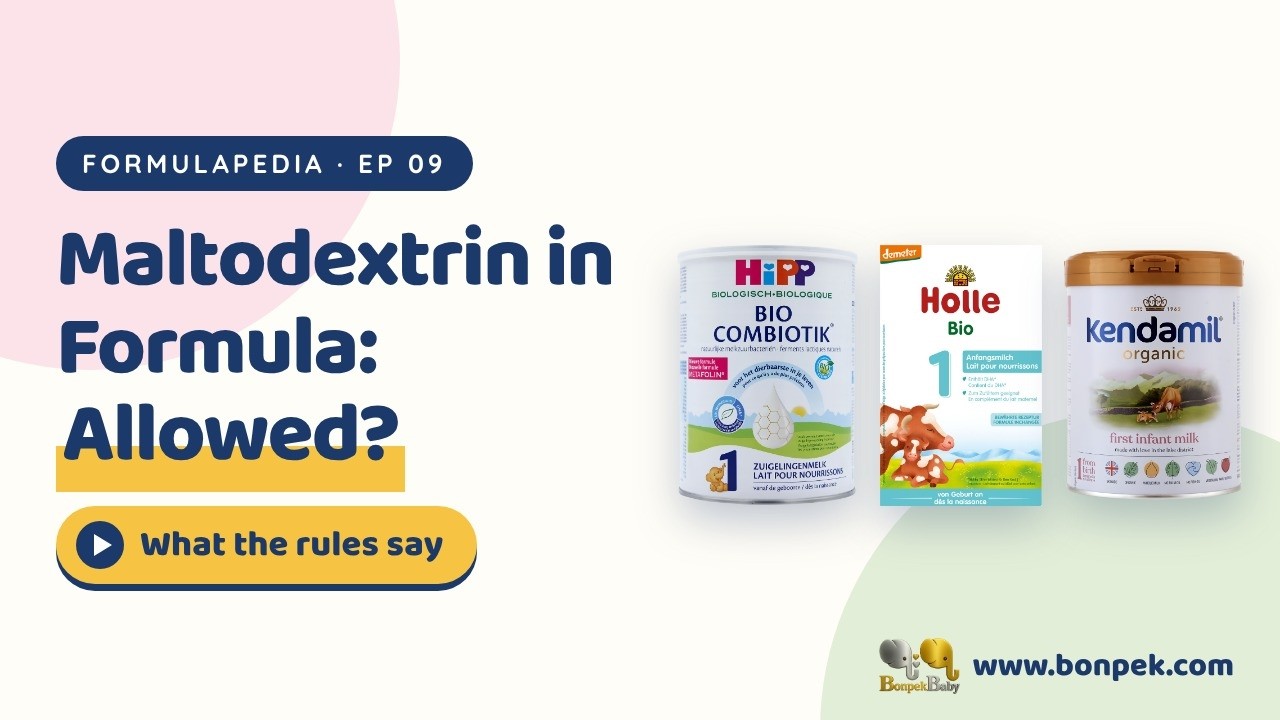
Watch the video version of this guide on YouTube. General information only, not medical advice. Always follow your pediatrician's guidance.
What the EU Rules Allow
For infant formula (first formula, often labeled PRE or Stage 1), Annex I of Regulation (EU) 2016/127 sets total carbohydrate at 9 to 14 g per 100 kcal and allows only these carbohydrates: lactose, maltose, sucrose, glucose, glucose syrup or dried glucose syrup, maltodextrins, and pre-cooked or gelatinised starch. The two starches must be naturally free of gluten. Anything else, including fructose and honey, is not on the list for infant formula. Follow-on formula (Stage 2 and later) has its own annex with its own rules, so the numbers in this guide describe first formula unless it says otherwise.
Lactose
Lactose is the natural carbohydrate of milk. EU rules set a minimum of 4.5 g per 100 kcal and no maximum. The minimum does not apply when soy protein isolate makes up more than half of the protein, or when the product carries a lactose free statement. That exception is why a lactose-free formula must replace lactose with other permitted carbohydrates.
Maltodextrin
Maltodextrin is a carbohydrate made by partly breaking down starch. It is on the permitted list, and Annex I sets no numeric limit for it. You will see it in some formulas alongside lactose, and in some lactose-free and specialist formulas as a main carbohydrate.

Glucose Syrup
Glucose syrup, and its dried form, is made by breaking starch down further than maltodextrin. In infant formula the rules are tighter. It may be used only in formulas based on cow's or goat's milk protein or soy isolate, its dextrose equivalent must not exceed 32, and the glucose it contributes must not exceed 0.84 g per 100 kcal. In formulas made from hydrolyzed protein, the separate glucose limit of 2 g per 100 kcal applies instead. Dried glucose syrup is what some labels elsewhere call corn syrup solids when it is made from corn.
Starch
Pre-cooked or gelatinised starch has no minimum. It is capped at 2 g per 100 ml and at 30% of the total carbohydrate. Some thickened and later-stage formulas use ingredients like this. Whether a thickened formula is right for your baby is a conversation for your pediatrician, not a label judgment.

Rules at a Glance (Infant Formula)
| Carbohydrate | EU rule (Regulation 2016/127, Annex I) |
|---|---|
| Lactose | At least 4.5 g per 100 kcal; no maximum; minimum waived for lactose-free or mostly soy-protein formula |
| Maltodextrin | Permitted; no numeric limit in Annex I |
| Glucose syrup / dried glucose syrup | Milk-protein or soy formula only; dextrose equivalent up to 32; glucose it supplies up to 0.84 g per 100 kcal |
| Starch (pre-cooked or gelatinised) | Up to 2 g per 100 ml and 30% of carbohydrate; must be gluten free |
| Sucrose and glucose | Hydrolyzed-protein formula only; sucrose up to 20% of carbohydrate; glucose up to 2 g per 100 kcal |
| Fructose and honey | Not on the permitted list for infant formula |
An ingredient being on the label is not a red flag by itself. What matters is whether it is permitted for that formula, within its limit, and whether it suits your baby. Maltodextrin, glucose syrup and starch are each permitted under specific conditions.
How to Read the Label
- Ingredient list: ingredients are listed from the largest amount to the smallest. Check where lactose sits and whether maltodextrin, glucose syrup or starch follow it.
- Nutrition table: the carbohydrate line shows the total per 100 ml of prepared formula. Some packs also show a sugars line, which includes lactose. Our step-by-step label guide covers the whole panel.
- Stage: a formula's carbohydrate mix often changes between stages, so check each one.
- Product type: lactose-free, anti-reflux and hydrolyzed formulas are built differently on purpose. Use them under your pediatrician's guidance.
Examples From Bonpek Brands
Here is how the carbohydrate line looks across the lines we carry, according to our European formula ingredients guide.
| Line | Carbohydrates |
|---|---|
| HiPP Bio Combiotik (German) | Lactose only at PRE and Stage 1; some starch or maltodextrin joins lactose from Stage 2 |
| HiPP Bio Combiotik (Dutch) | Lactose only; no added starch at any stage |
| Holle cow and goat ranges | Lactose only at PRE and Stage 1; some maltodextrin or starch joins lactose from Stage 2 or 3 |
| Kendamil Organic and Bio Nature | Lactose only at every stage |
| Jovie goat and NannyCare goat | Lactose is the sole carbohydrate across the line |
| Aptamil Lactose Free First Infant Milk | Per Nutricia's product page, glucose syrup is the first ingredient, followed by maltodextrin, in place of lactose |
Formulations can change between stages and production runs, so the ingredient list on your pack and on the live product page is the final word. Browse HiPP formulas, browse Holle formulas, browse Kendamil formulas or see the Aptamil Lactose Free First Infant Milk page for the lactose-free example above.

Frequently Asked Questions
Is maltodextrin allowed in European baby formula?
Yes. Regulation (EU) 2016/127 lists maltodextrins as a permitted carbohydrate and sets no numeric limit for them in Annex I.
Is glucose syrup allowed in infant formula?
Under conditions. It may be used in formulas based on cow's or goat's milk protein or soy isolate, with a dextrose equivalent of no more than 32 and a limit on the glucose it supplies.
How much lactose must infant formula contain?
At least 4.5 g per 100 kcal, with no maximum. The minimum is waived for lactose-free formula and for formula where soy isolate makes up more than half of the protein.
Is fructose or honey allowed in infant formula?
Neither is on the permitted carbohydrate list for infant formula in Annex I of Regulation 2016/127.
Why would a formula use starch?
Starch is permitted up to 2 g per 100 ml and 30% of carbohydrate, and some later-stage and thickened formulas use it. Ask your pediatrician if you are considering a thickened formula for reflux.
Which Bonpek formulas are lactose-only?
According to our ingredients guide, Kendamil Organic and Bio Nature, Jovie goat, NannyCare goat and the HiPP Dutch line are lactose-only, and the HiPP German and Holle lines are lactose-only at PRE and Stage 1. Check the pack for your stage.
Leave a comment