







Storing Imported Baby Formula: Safe Handling Steps
Last Updated: November 2, 2026
Quick Summary
Store unopened imported baby formula in a cool, dry place away from heat and sunlight, and keep opened powder sealed and dry in its airtight container. Use opened powder within one month, and use mixed formula within two hours of preparation, or refrigerate it and use within 24 hours.
- Read the date carefully, since imported tins may use day/month or year/month/day formats.
- Discard any tin that arrived dented, bulging, rusted, torn, or heat-exposed.
- Keep the scoop in its holder, never sitting inside the powder.
- Do not store powder in the refrigerator, because cold surfaces cause condensation.
- Discard prepared formula left at room temperature after two hours.
Table of Contents
- Step 1: Check the Label, Date and Packaging Before You Store
- Step 2: Store Unopened Imported Formula in a Cool, Dry Place
- Step 3: Keep Opened Powder Sealed and Dry
- Step 4: Know How Long Prepared Formula Can Sit at Room Temperature
- Step 5: Store Ready-to-Feed Formula After Opening
- Step 6: Refrigerate Made Formula and Track the Time Limit
- Next Step: Stock Your Fridge and Feeding Kit for Imported Formula
- Frequently Asked Questions
Step 1: Check the Label, Date and Packaging Before You Store
Storing imported baby formula safely starts before the tin ever reaches your cupboard. A common first mistake is tucking a new pack away without reading the label. Imported products make that mistake easier to commit, because the date, the lot code, and the storage directions may be printed in a format you have never seen. Take a few minutes to decode the packaging before you store anything.
Find and read the date correctly
Every manufacturer prints an expiration or use-by date, but imported tins do not all write it the same way. A date printed as day/month/year (for example, 05/11/2027) means November 5, not May 11.
Also distinguish between two different dates:
- Expiration or use-by date: the last date the sealed product should be used.
- Best-by or best-before date: a quality date; the product is still safe after it if the seal is intact, but nutrient levels may decline.
Write the date you buy it on the box, and note whether it is a use-by or a best-by date so you know how much margin you have.
Decode the lot code
The lot code (sometimes called a batch code or production code) is the string of letters and numbers stamped on the can, lid, or bottom of the tin. It is not a date, but it identifies the production run. Save it with your receipt. If the manufacturer ever issues a recall or a safety notice, the lot code is how you find out whether your tin is affected.
Read storage directions on foreign-language packaging
Imported labels may be printed entirely in another language. Do not assume the storage directions match what you are used to. Look for these cues:
- A translation panel: many exporters print a secondary-language panel or a sticker with English storage directions. Check the back and the side of the tin, not just the front.
- Manufacturer website: the brand's site usually lists storage instructions by product name and lot. Search the product name and the word "storage" or "preparation."
- Pictograms: a snowflake means refrigerate; a sun with a slash means keep out of direct sunlight; an open-jar symbol with a number (such as "1M") means use within one month of opening.
If you cannot find storage directions in a language you read, contact the manufacturer or the seller before you open the tin. Do not rely on a translation app for safety-critical instructions such as water temperature or refrigeration time.
Inspect the packaging for shipping damage
Imported tins can sit in warm shipping containers and warehouses before they reach you. Inspect every container before it goes on the shelf:
- Dents and bulges: a bulging lid or can is a sign of pressure change or spoilage. Do not use it.
- Torn foil pouches and cracked seals: these let air and moisture in. Set the pack aside and ask the seller about a replacement.
- Rust: rust on the seam or lid can compromise the seal.
Keep these points in mind when you check a new pack:
- Expiration date: confirm it is still well ahead of today, and note whether it is a use-by or best-by date.
- Lot code: save it with your receipt in case you ever need to report a problem.
- Seal and lid: make sure the seal is intact and the lid closes tightly.
Watch out: A tin that arrived warm, dented, or bulging should not go on your shelf, even if the date looks fine, packaging damage and heat exposure can matter more than the printed date.
Step 2: Store Unopened Imported Formula in a Cool, Dry Place
Unopened formula keeps best in a cool, dry spot away from heat and moisture. A pantry shelf or a closet on an interior wall works well.
Heat and humidity are the two enemies of powdered formula. Both can cause clumping and nutrient loss over time. Storing it on a stable shelf, not near appliances or a window, keeps conditions steadier.
Our advice for unopened tins:
- Keep the tin in its original box or wrapper until you open it.
- Store it off the floor, away from pipes and the dishwasher.
- Rotate stock so the oldest tin gets used first.
Many parents ask about buying in bulk. Buying several tins can save money, but only if you can use them before their expiration dates. Plan your purchases around how much you feed each week.
Step 3: Keep Opened Powder Sealed and Dry
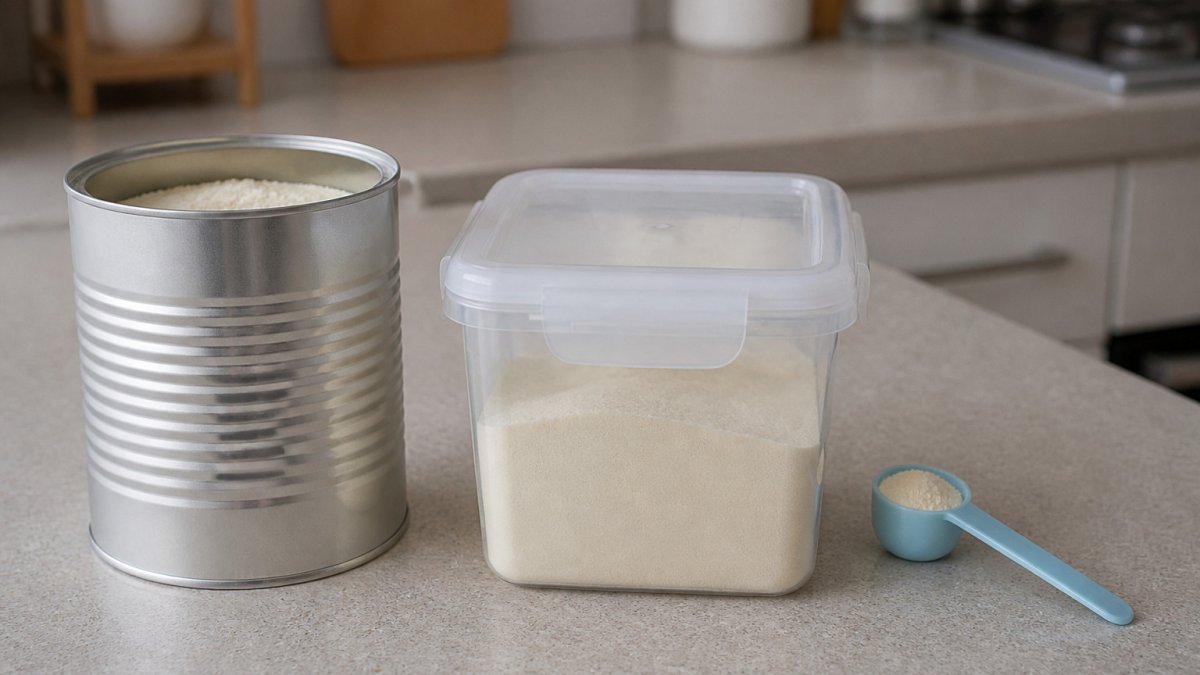
Once you open a tin, moisture is the main risk. Kitchen air carries humidity, and every time you leave the lid off, that moisture can reach the powder. Powdered formula is hygroscopic, it pulls water vapor out of the air, so clumping, caking, and nutrient loss start long before the powder looks wet. The goal is to keep the powder dry between every scoop, not just to close the lid at the end of the day.
Reseal the original container first
The manufacturer's tin is designed to keep the powder dry. Keep the original lid and press it down firmly after every use. A dedicated airtight container helps a lot.

A dedicated airtight container helps a lot. The HiPP Formula Storage Airtight Container (HiPP Formula Storage Airtight Container) is an airtight box for an opened pack of formula powder, with a scoop holder built into the lid.
Handle the scoop correctly
The scoop is the most common source of moisture and contamination. Follow these steps every time you prepare a feed:
- Wash and dry your hands before you touch the formula.
- Open the container and take out one level scoop.
- Put the scoop in its holder, not back into the powder.
- Close the lid right away.
A common mistake is leaving the scoop sitting in the powder. A damp scoop left in the tin can introduce moisture and bacteria. Keep it in the holder instead. If your container has no holder, rest the scoop on a clean, dry saucer beside the tin, never inside it.
Control condensation and humidity
Condensation forms when a cold container meets warm, humid air. In a humid kitchen, keep the tin closed between scoops and avoid opening it right after a hot shower or while a pot is boiling. If you live in a humid climate, store the tin in an interior closet rather than on an open shelf near a window or the dishwasher.
Write the open date and track the window
Write the open date on the container. Most formulas should be used within one month of opening, according to the CDC guidance on infant formula preparation and storage.
HiPP Formula Storage Airtight Container →
Watch out: Powder that has absorbed moisture may look normal but can support bacterial growth, if you are unsure whether a tin stayed dry, err on the side of discarding it rather than feeding it.
The table below summarises the key storage limits and handling points covered in this section.
| Item | Value | Note |
|---|---|---|
| Opened powder window | One month | Check the label for your product's exact window |
| Scoop storage | Holder or saucer | Never leave the scoop sitting in the powder |
| Powder in refrigerator | Avoid | Cold surfaces cause condensation |
| Open container | Write open date | Track the window from opening |
| Discard signs | Clumping, odour, colour change | Discard before the window ends |
Step 4: Know How Long Prepared Formula Can Sit at Room Temperature
Prepared formula has a short window at room temperature. Once you mix powder with water, bacteria can grow quickly, so timing matters more than most parents expect.
According to the FDA guidance on handling infant formula safely, use prepared formula within two hours. If your baby does not finish a bottle in that time, discard what is left. Do not save it for the next feed.
Use this quick rule:
- Within 2 hours of mixing: Safe to feed.
- After 2 hours at room temperature: Throw it out.
- Partly drunk bottle: Discard it after the feed. Do not refrigerate it for later.
The two-hour clock starts when the bottle is prepared or when your baby begins feeding, depending on your product and guidance. When in doubt, use the shorter window.
Step 5: Store Ready-to-Feed Formula After Opening
Ready-to-feed formula comes in liquid bottles or cartons, and it is easier to handle than powder. But once you open it, the storage rules tighten.
Many parents ask how long ready-to-feed formula lasts after the seal is broken. The answer depends on the product, so read the label first.
Ready-to-feed formula is best for:
- Travel and outings, when you cannot mix powder on the spot
- Nights, when speed matters more than cost
- Babies who need a consistent, measured feed
Do not pour ready-to-feed formula into a different container to store it.
Step 6: Refrigerate Made Formula and Track the Time Limit
If you mix a bottle and your baby will not finish it right away, refrigerate it immediately. The CDC guidance on infant formula preparation and storage says prepared formula not used within two hours should go in the fridge and be used within 24 hours.
Cool the bottle quickly, then store it toward the back of the refrigerator, where the temperature stays most stable. Put the bottle on a shelf rather than the door, which warms up each time it opens.
Track the time from the moment you mixed the bottle. A simple habit helps:
- Write the time on a piece of tape on the bottle.
- Use the bottle within 24 hours of mixing.
- Discard anything older than that, even if it looks fine.
Warming a refrigerated bottle is safe when done carefully. Warm it in a bowl of warm water, not in the microwave, which can create hot spots. Test the temperature on your wrist before feeding.
Next Step: Stock Your Fridge and Feeding Kit for Imported Formula
Once your formula is stored correctly, the next step is to set up a feeding kit that works for your routine. Keep a clean airtight container at home and a small portable option for outings.
When you are away from home, carry measured powder dry rather than mixed formula. The HiPP Portable Formula Portion Dispenser Storage (HiPP Portable Formula Portion Dispenser Storage) is a set of three screw-on containers for pre-measured formula powder, so you can carry measured powder dry and mix fresh feeds as needed.

Before you shop, make a short checklist:
- Airtight container for opened powder
- Portable portion containers for outings
- Clean bottles and a bottle brush
Storing imported formula well takes a little planning, but the habits are simple: check the label, keep powder dry and sealed, and track every time limit.
Frequently Asked Questions
How long can prepared formula sit at room temperature?
Prepared formula should be used within 2 hours of when feeding starts, according to the CDC and FDA. If a bottle is not finished in that window, it should be discarded rather than saved. Formula that has been left at room temperature for longer than two hours is not safe to refrigerate and reuse. Check the time from the moment you mix or warm the bottle, and note it if you are feeding in a busy or distracted setting.
Can you store baby formula in the refrigerator?
Yes. Prepared formula that will not be used right away should be refrigerated immediately and used within 24 hours, according to CDC guidance. Keep it at the back of the fridge rather than the door, where the temperature fluctuates more. Label each bottle with the time it was made so you can track the 24-hour limit. Do not refreeze formula once it has been thawed.
How long is formula good for after opening the container?
Most formulas should be used within 1 month of opening, according to CDC guidance. Write the opening date on the container when you first open it. Reseal the lid tightly after every scoop, keep the container dry, and avoid leaving the scoop inside the powder between feeds. If the powder looks clumped, smells off, or the container is damaged, do not use it.
What should you do if imported formula gets too hot during shipping or storage?
Check the packaging for dents, swelling, or moisture before using it, and contact the seller or manufacturer for guidance if the product may have overheated. Shipping and customs can expose formula to heat, and the packaging instructions and label dates are the first things to check. For product-specific or medical concerns, ask your pediatrician before feeding. The research available for this article does not establish a specific temperature threshold for imported formula, so do not rely on a guessed cutoff.

Leave a comment